
Welcome to Modern Agriculture!

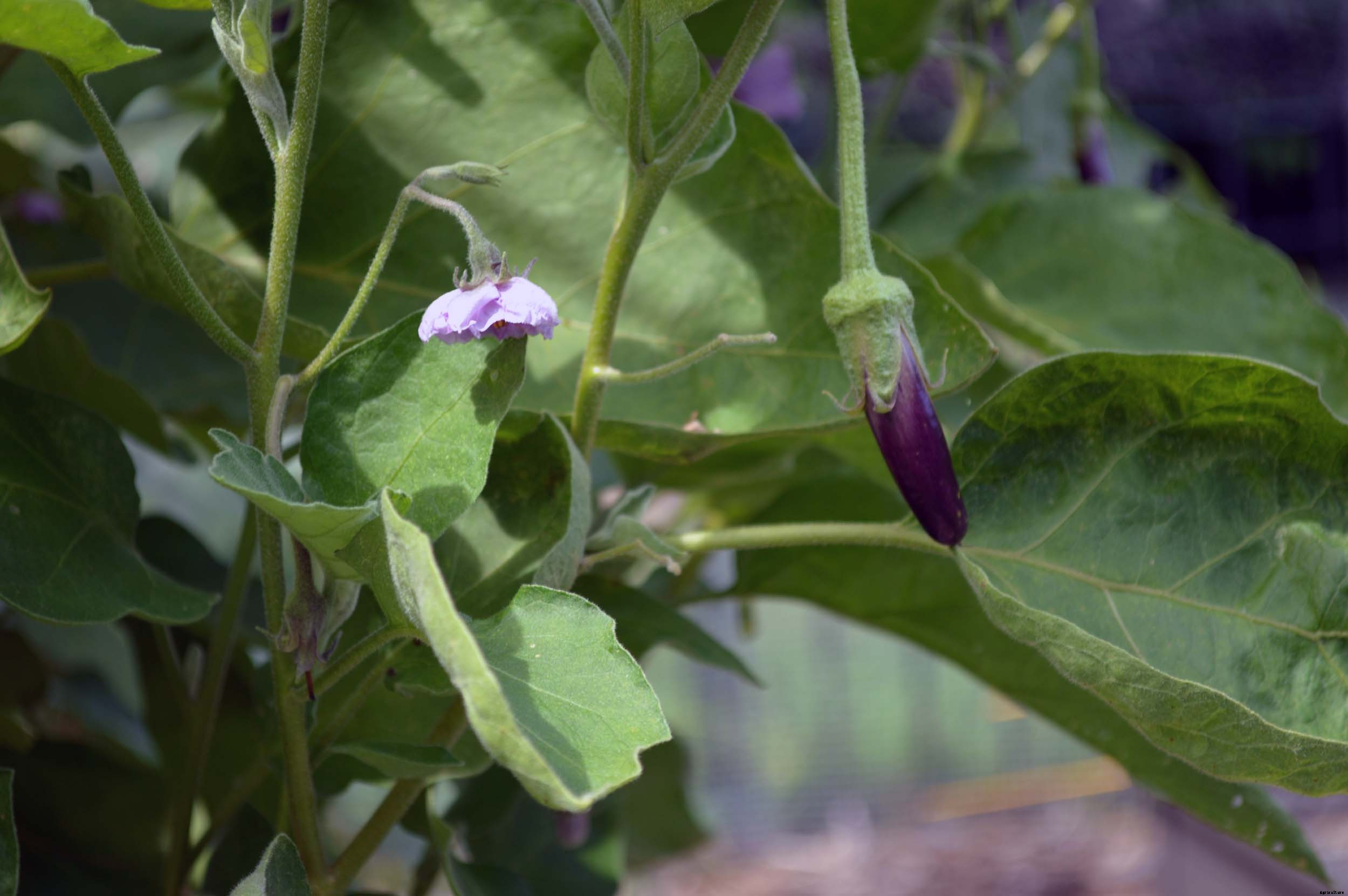
There are two things that I love about eggplant. First, is the beauty eggplant adds to the garden with their beautiful fruits and blooms. Second, is making Eggplant Parmesan. A friend shared her recipe with me, and the link is included as part of this post. Read on to learn about how to successfully grow eggplant in your garden.
Eggplant is a warm-season annual that can either be started from seed or purchased as transplants. Eggplant, also known as aubergine, is part of the Solanaceae family. In addition, the Solanaceae family includes tomatoes, peppers and potatoes. This is an important fact because you should not plant any crop from the Solanaceae family in the same garden bed for two to three years. Rotating crops will reduce disease.
Eggplant comes in several varieties with the most common being a glossy black-purple, egg-shaped fruit that grows six to eight inches long. Lovely lilac color flowers form on the eggplant from which the fruit will grow. In addition, eggplant is mostly self-pollinated by wind and can also be pollinated by bees. In my experience, bees love eggplant flowers. Finally, eggplant is native to China and India
The greatest service which can be rendered any country is to add a useful plant to its culture.
Thomas Jefferson

Eggplants can either be started indoors from seed (8-10 weeks before the last frost) or purchased as transplants from a garden store. Eggplant is more cold sensitive than tomatoes and should not be planted outdoors until the nighttime temperature is consistently at or above 50°F. Germination is generally seven to ten days in temperatures between 60°F – 95°F.
If starting seeds indoors, any size container can be used if there is good drainage. First, plant seeds ¼ inch deep in a soilless planting medium and cover the container with plastic wrap. Next, place the container in a warm area or on a seedling heat mat. Once the seedling emerges, remove the plastic wrap and place the container in a window or under artificial lights for at least 16 hours a day. After the true leaves develop and the plant is five inches tall, it is important to ‘harden off’ the transplants before being planted in the ground.
Hardening off is the process of gradually acclimating the plant to the outdoors. This process can be done in a cold frame or by simply placing the plants outdoors for a couple of hours each day for one to two weeks. For a full guide on starting plants from seeds, see my blog post titled “The complete guide to starting plants from seeds indoors”.
If you purchase transplants from a garden store, ensure that you are purchasing healthy plants. The plants should be 10-12 inches tall and the leaves should not have any spots. Also, check the stems and the underside of leaves for evidence of pests or disease.
After transplanting, eggplant should be ready for harvest 65-80 days.


To successfully grow eggplant in your home garden, pay attention to the following:
Light: Eggplant like full sun with at least 6 hours of sunlight a day and are not bothered by the heat. Eggplant grows to a height of 2-4 feet and spreads 2-4 feet.
Soil: Eggplant needs soil that is well-drained and amended with organic matter (e.g. the addition of compost and/or manures). Compost can be made at home or purchased from a garden center. For information on making compost at home, reference my blog titled “Recipes for Compost”. It is best to work compost into the soil in the fall for a spring planting.
Spacing: Follow the guidelines on the back of the seed package for plant spacing. Generally, eggplant is spaced 18-24 inches apart with the rows being spaced 30-36 inches apart. When setting out the transplant, also include a stake to which the eggplant can be attached as it grows.
Water: Eggplant require 1 inch of water a week and the soil should be kept evenly moist for the best fruit production. Avoid overhead watering as this can promote disease. Drip irrigation or soaker hoses are best for watering.
Fertilizing: Soil pH should be between 6.0 and 7.0. When transplanting, I add a half-strength mixture of fish emulsion to the transplant hole. After the transplants have been in the ground 2-3 weeks, side dress with a nitrogen-based fertilizer (like Blood Meal) for the next 2-3 weeks. Careful not to apply too much nitrogen as this will result in lots of leaves and less fruit.
Companions: Beans and potatoes are good companions for eggplant.
There are three things you can do to give your eggplant a good start:

There are several pests and disease that can impact successfully growing eggplant. The best prevention is raising healthy plants and keeping them healthy:
Common pests include:


Eggplant should be harvested when it reaches the size specified for the variety planted, the skins are shiny, and fruit is firm. Another test that can be performed to determine ripeness, is to press lightly into the skin of the eggplant. If the skin presses in and flexes back to its original position, this is an indication that the fruit is ripe and ready to harvest.
It is important to cut the plant from the branch and not attempt to pull off. Cut approximately 1-2 inches above the ‘cap’ at the top of the eggplant. Frequent harvesting is important to encourage new fruit development. Eggplant quality will diminish if left too long on the plant. It is best to use eggplant right after harvesting for the best flavor. While eggplant does not like the cold of the refrigerator, it will keep for about one week in the refrigerator.

Eggplant is generally not eaten raw and is not suitable for canning. Popular preparation techniques include grilling, baking, frying, and sautéing with other vegetables. My favorite way to prepare eggplant is to make Eggplant Parmesan.


Long Purple Italian (70-80 days to maturity)

Family: Solanaceae
Genus: Solanum
Species: S. melongena
Cornell University
University of Minnesota Extension
University of Missouri Extension


