Agriculture and agribusiness provide the largest source of livelihood in rural India. With the emergence of high-tech modern farming techniques, polyhouse technology has emerged as one of the leading techniques/ methods of higher crop yield and profit for farmers.
Polyhouse greatly reduces the dependence on natural elements like, rainfall, temperature, humidity and geographical conditions. By the use of computer-assisted technology, polyhouse has empowered farmers with the ability of creating microclimate inside the polyhouse for off season crop cultivation. Polyhouse has also enabled farmers to place any kind of soil in the polyhouse to grow a crop completely new to a particular geographical location.
Contrary to popular belief that greenhouse is a modern farming technique, it will come as a surprise to many that humans have applied green house farming concepts since 1st century AD, when the then ruling king, Tiberius Caesar, in Europe was advised to eat cucumber every day, round the year. It was then, when the concept of a climate controlled confined structure came into existence.
The concept of glasshouse/greenhouse dates back to 16th -17th century. However, greenhouse technology became more prominent and widely practiced after world war II with the development and introduction of polyethylene.
Now, with the introduction of polyhouse history and evolution, the question still remains: what is a modern polyhouse? and what exactly happens inside a polyhouse which makes it so special?
What is a polyhouse?
Modern polyhouse a framed structure, covered by transparent or translucent material, such as polyethylene. Polyhouse is made with the intention of partially or fully controlling the internal climate so that suitable climatic conditions for the growth of crop can be achieved round the year.
Contrary to old polyhouses which were made of wooden beams or low cost polyhouses which use bamboo as the primary support structure, modern poly house has a support frame of galvanized iron steel ( G. I Steel ). A polyhouse is covered with a high quality polythene (General specs : 200 microns thickness, UV, IR and Thermal Stability, antidust, UV blocking).
What are different types of polyhouses
Polyhouses can be classified in many ways based on their shape, technology used, construction material, cost, covering material and utility.
Following subsections will cover the types of poluhouses based on the above mentioned classifications:
1. Types of polyhouses based on shape
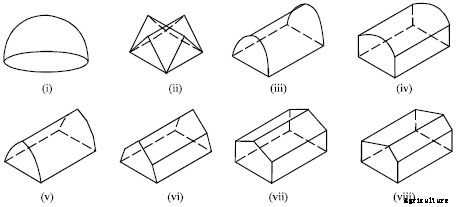
Poly houses can vary in shapes depending on the requirement and the budget.
Lean-to type polyhouse
The lean-to type of polyhouse is used when it is placed against the wall of an existing polyhouse structure for one or more of its sides. The roof of the existing polyhouse structure is extended with covering material.
It is best to have the whole structure facing south so that it receives adequate solar exposure. The length of the greenhouse can be as long as the building it is attached to, but the width is limited to either single or double-row plant benches.
In general, lean-to greenhouses have the advantage of being one of the less expensive structures. Polyhouses constructed using this design maximize sunlight and minimize roofing support requirements. The disadvantages include limited space, light, ventilation, and temperature control.
Even span type Polyhouse
Even span polyhouses are mostly constructed on the ground level with two roof slopes of equal width and pitch. Polyhouses of this type are used when the size of the polyhouse is small.
Plant benches are arranged in two or three rows in this type of polyhouse. A polyhouse structure with an even span costs more than a lean-to type polyhouse, but it has greater flexibility in design and is suitable for more plants.
In comparison to a lean-to type, this design is better shaped to maintain uniform temperatures inside the structure during the winter months. It has two side benches, two walks, and a large centre bench. In general, the span of a single span type ranges from 5 to 9 m, whereas the length is around 24 m, and the height is between 2.5 and 4.3 m
Uneven span type Polyhouse
Polyhouses with uneven spans are suitable for hilly or undulating terrain. Due to the varying width of the roofs on different sections of the structure, the structure can be easily adapted to the slopes of hillsides. Polyhouses of this type are rarely used since they cannot be automated.
Ridge and furrow type polyhouses
In this type of polyhouse design, several A-frame polyhouses are connected along their length. A gutter or furrow is located at the eave to collect rainwater and snow melt. The polyhouse structure has no side walls within it, which appears to be a structure with one large interior.
This reduces labour costs, minimizes automation costs, and enhances personal management, while at the same time consuming less fuel as there are fewer exposed wall areas.
In order to construct the frame structure of these polyhouses, snow must be considered, as snow cannot slide off the roofs as in the case of freestanding polyhouses, but instead melts. However, ridge-and-furrow polyhouses are widely used in northern European countries and in Canada, despite snow loads.
Saw tooth type polyhouses
Polyhouses of this type are similar to ridge and furrow types, though they provide natural ventilation through sawtooth-shaped roofs.
It can be opened to allow a continuous flow of fresh air to reduce the indoor temperature or it can be closed to maintain an optimal climate within the growing area. In addition to the side ventilation, the roof ventilation provides 25% of the total ventilation of the covered area. As a result of the arches’ shape, they provide excellent light transmission.
Quonset type polyhouse
Usually, the polyhouses of this type are interlocked either in a free-standing style or in an interlocking ridge and furrow arrangement. Support is provided by pipe purling running along the length of the quonset type polyhouse.
Polyethylene is generally used as a covering material. Polyhouses are ideal for building small, isolated cultural areas, and they are also more economical than gutter-connected polyhouses.
2. Types of polyhouses based on cost
Low technology polyhouse
A very small number of farmers use low-tech structures for production. Low technology polyhouses have a height of less than 3 metres.
Tunnel houses, the most common type of low technology polyhouses, provide poor ventilation since they lack vertical walls. Due to the lack of automation, this type of structure is relatively inexpensive. Nonetheless, this type of structure provides basic advantages for crop production as compared to an open field system.
There is still some limitation to the crop potential due to the growing environment, and crop management is somewhat difficult. Low-tech polyhouses generally produce suboptimal growing conditions that result in reduced yields and little reduction in the incidence of pests and diseases, but nevertheless provide a cost-effective entry into polyhouse farming technique.
Medium technology polyhouse
Polyhouses of medium technology are typically characterized by vertical walls. The size of a medium technology polyhouse wall is typically greater than 2 meters but less than 4 metres tall and less than 5.5 metres in total height.
In addition, they provide medium automation capabilities and usually use single or double skin plastic cladding. Medium-level polyhouses offer a reasonable economic and environmental basis for farming while balancing cost and productivity.
In medium-level polyhouses, crop production is more efficient than in open fields. There is more opportunity for non-chemical pest and disease management in this type of polyhouse, but overall, medium technology polyhouse horticulture has trouble reaching its full potential.
High technology polyhouse
The wall height of high-tech polyhouses is at least 4 metres, and the roof peak is at least 8 metres above ground level.
Structures such as these provide excellent crop production with full environmental customization. Roof vents and side wall vents are present in this structure. Polyethylene (two- or three-layer) sheets, are normally used as cladding materials for high level polyhouses.
The use of pesticides is also significantly reduced. While these polyhouses are capital intensive, they offer a highly productive, environmentally sustainable opportunity for an advanced fresh produce industry. It is always advisable to invest in high technology polyhouse.
3. Types of polyhouses based on utility
Active heating system polyhouse
During the night, the temperature inside the polyhouse decreases. In order to protect plants from the cold bite caused by freezing, some amount of heat must be provided.
There are several methods that are used to reduce the heat losses, including use of double layer polyethylene, thermopane glasses (two layers of factory sealed glass with dead air spaces between them). Heating systems, such as unit heaters, central heat, radiant heat, and solar heating systems are also employed.
Active cooling system polyhouse
In order to ensure that crops grow effectively during the summer months, it is recommended that the polyhouse temperature be reduced compared to the ambient temperature.
Accordingly, modifications are made to the polyhouse to allow large volumes of cooled air to be drawn into the polyhouse. Evaporative cooling with a fan or fog cooling are both used in this type of polyhouse. The structure of this polyhouse permits a roof opening of 40 percent and up to 100 percent in some cases.
Difference between greenhouse and polyhouse?
Essentially, a polyhouse or greenhouse is the same thing. A greenhouse’s covering material was traditionally glass, which was mounted on wooden frames. Thanks to advances in plastic technology, glass could be replaced with plastic material.
Since polythene is the most widely used material for covering instead of glass, greenhouses have come to be known as polyhouses in recent years.
Construction cost of polyhouse
The cost incurred for the construction of polyhouse varies depending on the size of the polyhouse and the technology used in the polyhouse. As discussed earlier, depending on the level of technology used, following are the approximate average cost of poluhouse:
Low cost/technology polyhouse (excluding fan system and cooling pads) = 500 – 700 Rupees / sq. m.
Medium cost/technology polyhouse (including fan system and cooling pads) = 1000 – 1500 Rupees / sq. m.
High cost/technology polyhouse (Fully automatic and climate controlled) = 3000 – 4000 Rupees /sq. m.
Subsidy in polyhouse
Government subsidy, under Mission for Integrated Development of Horticulture (MIDH), on polyhouse construction varies from state to state. The subsidy can range fro 50% to 80%. The details of the subsidy and the payment terms of the total subsidized amount shall be discussed with the respective state Department of horticulture (DoH).
The subsidy assistance amount from the government is only given to the beneficiary via online bank transfer. The subsidy is transferred in stages:
1st stage subsidy payment : After ADH (Assistant director of horticulture) inspection report stating that the structure of the unit is completed without cladding material.
2nd Stage subsidy payment : After joint inspection (government and third party inspection) report is released stating the completion of the polyhouse construction.
Note: The construction of polyhouse has to be completed within 60 days of sanction of the application.
Terms and condition and eligibility for polyhouse subsidy
Following are the eligibility criteria for availing polyhouse subsidy:
To avail of subsidy, the applicant must be the owner of the piece of land on which the project will be constructed, or the lessee must produce an affidavit for a minimum period of 10 years duly notarized if the land is leased.
A beneficiary who has already received the maximum amount of subsidy is not eligible.
Minors are not eligible
The pH of irrigation water should range between 5.5 and 7.0, and the EC should range from 0.1 to 0.3 ms/cm.
The pH of the type of soil used as propagating media should range from 5.5 to 6.5, and the EC should range from 0.5 to 0.7 ms/cm.
Training programs and exposure tours should be provided to the selected beneficiaries on concepts of protected cultivation, high-tech floriculture, and high-value vegetables.
The estimated project details designed by the technical consultant in accordance with the technical standards of MIDH should be attached to the application.
The proposal/application should include soil and water analysis reports from reputable labs.
Farmer is responsible for the erection of the Polyhouse
There should be a display board outside the polyhouse that depicts the “Department of Horticulture” (with the MIDH logo).
The beneficiary/Firm will receive the subsidy through online transfer after committee members have jointly inspected.
The Polyhouse/Shadenet House shall be documented with photos of every stage of construction and submitted to the State MIDH cell along with a joint inspection report indicating the beneficiary, the extent, the village and the Mandal.
Photographs should clearly show the board, unit, farmer, and members of the joint inspection team.
Process of subsidy on polyhouse after project approval
Farmer registration of the beneficiary is done through hortnet ( Ministry of Agriculture and Farmers Welfare).
The District Administration (DMC) will issue administrative sanctions.
Upon completion of a polyhouse training program, the farmer should hire a registered firm / company that is approved by the Department for the installation of polyhouses under MIDH specifications.
Upon issuance of the administrative sanction, the Firm has 60 days to complete the construction of Polyhouse.
A joint inspection committee is formed by ADH (Assistant director of horticulture) which includes himself along with DDH ( District director of horticulture), Horticulture Officer, Horticulture Engineer and Banker (in case of bankable project).
Process to receive subsidy of construction of polyhouse
The beneficiary is required to submit the work completion certificate to the ADH.
For further processing, the beneficiary must submit all the original bills for the expenses incurred to the ADH.
ADH will coordinate with the members of the joint inspection committee, as well as arrange for inspection of the completed polyhouse.
A joint inspection report will be submitted by the committee after the unit is inspected by the committee.
The joint inspection report must be accompanied by a photograph of the unit and the farmer and committee members.
It is mandatory to submit the joint inspection report in the prescribed format to the State MIDH cell together with the DMC approval for the release of subsidy.
In order to receive subsidy, the ADH responsible should upload the field photos and invoices to Hornet.
Subsidies must be paid to beneficiaries/Firms via online transfer only.