Acid Lime Cultivation Practices:
Introduction to Acid Lime Cultivation Practices:
Acid limes are one of the best fruits grown and used in India. It is appreciable not only for its appearance and pleasing flavor, excellent fruit qualities. These acid lime are used as fresh fruit, preparing the pickles and many beverages. The best part of it is having plenty of vitamin ‘C’ which can provide good antioxidants. Commercial cultivation of acid lime is definitely a most successful and profitable business due to lime demand throughout the year. In the following article let us talk about month wise acid lime cultivation practices in India.
Acid Lime Cultivation Practices – Major Acid Lime Cultivation States in India:
India is the largest producer of acid lime in the world. When it comes to Indian states, Andhra Pradesh, Telangana, Maharashtra, Tamil Nadu, Karnataka, Gujarat, Bihar, and Himachal Pradesh are being major producing states of acid limes.
Acid Lime in Indian Languages:
Hindi – Numbu, Telugu – Nimma kaya, Malayalam – Cherunaranga , Tamil – Elumichai pazham, Oriya – Gangakulia lebu, Kannadas- nimbe hannu, Marathi – Eidilimbu, Bengali – পাতি লেবূ, Assamese – Gol nemu, Punjabi – Nimbha, and Gujarati – leelu limbu.
Acid Lime Cultivation Practices – Acid Lime Varieties:
The following varieties of acid limes grown in India.
- Andhra Pradesh and Telangana: Balaji, and Petlur Selection 1
- Tamil Nadu : PKM – 1
- Karnataka : Coorg Lime
- Maharashtra : Vikram, Pramlini, Chakradhar Sai Sharbati, and Akola Lime
- North India : Kagzi lime
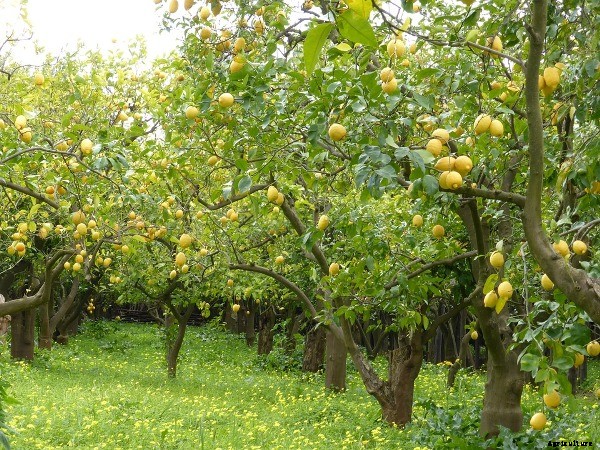 Lemon Orchard.
Month Wise Acid Lime Cultivation Practices:
- Acid Lime Cultivation Practices – April month:
- In the month of April, ensure the suitability of soil for proper growing conditions of acid limes. You need make this happen before onset of monsoon so that the field will be ready for planting before rainy season starts. As part of this, profile pits size of 3 ft x 3 ft x 3 ft should be dug.
- You should observe the soil for any lime nodules or sheet rock presence. If you find any such, those soils must be avoided for acid lime farming.
- Avoid black cotton or ill-drained soils or waterlogging soils as these soils are not suitable for growing acid limes.
- Collect the sample soil for one foot of profile pit for sending it to soil testing lab.
- Based on the soil fertility and suitability, you will come to know whether the soil is suitable for acid lime plantation. Sometimes you may be ending up supplementing the nutrients and micro-nutrients in the soil based on soil test result.
- Soil PH of 6.4 to 7.5 should be considered as ideal for an acid lime crop. If the soil pH value is below 6.1 and above 8.6, these soils are not suitable and should be avoided.
- Acid Lime Cultivation Practices – May month:
- In the month of May, it is required to prepare a layout for pit digging in the field.
- Carry out the activity of ploughing by Mould Board Plough(MB plough) to clear the field from unnecessary weeds. This could also be helpful in levelling the soil.
- Ensure the correct alignment and peg marking for a pit digging with 6 meters (18 feet) spacing between plants and rows.
- Basically, Acid Lime plantation requires a pits size of 60 cm x 60 cm x 60 cm. In the case of HD lime plantation (high density), the pits size may change.
- When it comes to pit digging, ensure the dugout topsoil with a depth of 1 ½ feet (18 inches) to the right side of the pit and bottom soil with a depth of 1 ½ feet (18 inches) to the left side of the pit in the field.
- Allow the pits for sunlight exposure so that the pits become dry and pest and disease free. Most of the time, plants are attacked by soil-borne pests and disease such as termites due to moisture. Make sure these pits are dried in sun for at least 15 to 20 days before filling the pits.
- Never buy the planting material from unknown sources. If you are planning the lime plantation on large scale or commercial growers should procure quality and high yielding lime planting material from certified If you any question about lime plant variety or yield, you can talk to the technical officer in the local horticulture department.
- Don’t forget to select suitable quality, disease resistant high yielding hybrid lime varieties for quality produce and profits.
- Acid Lime Cultivation Practices – June month:
- In this month, you can fill each pit with topsoil mixed with 20 to 25 kg of well-decomposed farmyard manure (FMY) like cow dung or any other garden compost along with 1 kilo of single super phosphate and 1 kg of neem cake and 100 grams of 10% Follidol dust.
- Make sure to fill these pits with the soil at least six inches (6’’) above the ground level. This can help to settle the soil to ground level at the time of lime plantation.
- Secure the field with thorn fencing to prevent trespassing of cattle and other predators.
- You should mark out for trench cutting and complete the trench cutting for drip system installation in the plantation.
- Inter-crops are an excellent option to earn some additional income during the initial years of lime plantation. Any inter-crops can be sown with the onset of monsoon (rainy season).
Read: Sudangrass Cultivation for Dairy Animals.
- Acid Lime Cultivation Practices – July month:
- In this month, you have to procure quality disease-free seedlings plant material from the certified nurseries.
- Make sure to have the budding is 15 cm above the soil.
- The selected acid lime seedling or budded plant should be 7 to 9 months old at the time of procurement. Make sure the bud union is perfect without any incompatibility.
- Make sure to cut terminal tender shoots (tip-offs) at the time of uprooting the plants from the nursery beds. Then, these should be packed in gunny bags.
- Transport the planting material (seedlings) without any damage to the main planting field.
- We need to maintain constant moisture until seedlings are planted. You need to keep the saplings near the water source and irrigate them frequently till planting is done in the field.
- If rains are delayed, the dug pits in the field should be soaked by giving light irrigation.
- Level the pits to ensure that the soil in the pit is at ground level at the time of planting.
- Plant the saplings in the prepared pits without disturbing the ball of earth around the root system.
- After planting, ensure that the bud union is six inches (6’’) above the ground level.
- Carry out irrigation immediately after transplanting in the field.
- Lime plants require lots of water. You can provide the water every 3 to 4 days interval during the first month of the plantation and later at 7 to 8 days interval, provided there are no rains during the initial 2 years. Using drip irrigation is recommended in the lime plantation. It not only saves water but also helpful in using fertilizers efficiently and controlling weed growth.
- Acid Lime Cultivation Practices – August month:
- In this month, plant care is an essential task. Usually, new growth on planted lime saplings starts in 2 weeks. There is a possibility of Citrus caterpillar attack on new growth of the plants.
- Spray Endosulphon @ 2 ml/liter of water at every 2 weeks interval to control citrus caterpillar (leaf-eating).
- Controlling weeds in the lime orchard is very important and it should be done at least once in 3 to 4 weeks during the rainy season to control weeds.
- Apart from weed control, keep the plant basins always clean to retain the maximum supplied water.
- You can provide mulching material at the plant basin to prevent moisture loss and soil erosion. Mulch material also can turn in organic compost after some time. The main advantages of mulching are to prevent any growth of weeds at the plant basin. Paddy husk or paddy straw or ground nut shells are ideal mulch materials. Nowadays, people are using black plastic mulch material as well.
- Make sure to remove the side shoots on the rootstock. Generally, thick green succulent shoots will appear above the bud joint. (These are called as water shoots).
- These shoots should be removed from the base. These shoots will unproductive and takes lots of energy from the lime plant.
- In case of floods, heavy rains in your region, provide soil drainage as soon as possible otherwise plants will be attacked by fungus and also leads to leaching of nitrogen due to ill-drained conditions. It is not at all good having the water stagnated for a long time in the orchard. You can expect to yellow of lime plant leaves and wilting of plants due to waterlogging conditions.
- In the waterlogged situation, pour 10 liters of copper oxychloride solution by dissolving @ 3 grams/ 1 liter of water in the affected lime plant basin.
- Acid Lime Cultivation Practices – September month:
- Usually, micronutrient deficiencies are observed in the soil. In this case, spray comprehensive micronutrient solution prepared by dissolving the following chemicals in 1 liter of water.
- Zinc sulphate: 5 grams
- Ferrous sulphate: 2 grams
- Magnesium sulphate: 2 grams
- Manganese sulphate: 2 grams
- Borax: 1 gram
- Lime: 6 grams
- Urea: 10 grams
Fertilizers – following fertilizers to be applied as a first top dressing for each pit as mentioned below.
- Urea : 120 grams/pit/plant
- Single Super Phosphate : 150 grams/pit/plant.
- Murate of Potash: 75 grams/pit/plant.
- Fertilizers should be applied at least 6 to 7 inches away from the plant and irrigation should be carried out immediately after the application of fertilizers.
- In case you notice leaf miner (this can cause canker disease) on emerged leaves after the application of
- fertilizers and micronutrients, you can control them by spraying Dimethoate @ 2ml/ 1 liter of water.
- Other pests are aphids and these can attack the new tender shoots. This can result in leaf curl. These aphids can be controlled by Di Methoate @ 1 gram/1 liter of water.
- Green mites and red mites can attack the leaves causing white spots on the lower surface of the leaves. Spraying wettable sulphur (80% W.P) @ 3 grams/ 1 litre of water can control these.
- Acid Lime Cultivation Practices – October month:
- In this month, if you notice any dead plants, gap filling should be carried out by replacing the dead plant with other healthy plants.
- Make sure to remove the criss-cross branches and water shoots for new growth of the plant.
- In India, if your region falls under high rainfall zone, it is advised to take up the lime plantation in October to November months.
- In case you did not cultivate inter-crops in June to July month, you can take it up in this month and can sow inter-crops for Rabi season.
- You can repeat spraying wettable sulphur (80% W.P) @ 3 grams/1litre of water in this month.
- Acid Lime Cultivation Practices – November month:
- In this month, work on soil at the plant basins and mulching should be done.
- You can remove the criss-cross & any dried branches along with water shoots of the plants.
- Make sure that no side branches develop on the main trunk up to a height of 2 ft from ground level.
- You can repeat spraying of wettable sulphur (80% W.P) @ 3 grams/ 1 liter of water.
- Acid Lime Cultivation Practices – December month:
Fertilizers: The following fertilizers should be applied as a second top dressing for each pit as mentioned below.
-
- Urea : 100 grams/plant/pit
- Single Super Phosphate: 150 grams/plant/pit
- Murate of Potash: 75 grams/plant/pit
- Make sure to apply these fertilizers at least six inches away from the plant base. For maximum utilization of fertilizer, you should irrigate the pits immediately after application.
Micro-nutrient deficiencies: If any micronutrient deficiencies are observed, spray comprehensive micronutrient solution which is being prepared by dissolving the following chemicals in 1 liter of water.
-
- Zinc sulphate: 5 grams
- Ferrous sulphate: 2 grams
- Magnesium sulphate: 2 grams
- Manganese sulphate: 2 grams
- Borax: 1 grams
- Lime: 6 grams
- Urea: 10 grams
- Acid Lime Cultivation Practices – January month:
- In this month, to control weed and improve soil aeration, carry out weed control and soil working at plant base.
- To prevent soil moisture and control weeds, mulch the plant basins with paddy husk or paddy straw or ground nut shells.
- Acid Lime Cultivation Practices – February month:
- In this month, water the lemon plants at 4 to 5 days interval regularly.
- Acid Lime Cultivation Practices – March month:
Fertilizers – This would be third top dressing of fertilizers to be applied per each pit/plant as mentioned below.
-
- Urea: 100 grams/plant/pit
- Single Super Phosphate: 150 grams
- Murate of Potash: 75 grams
- Make sure to apply these fertilizers at least six inches away from the plant base and carry out immediate irrigation for effective utilization of fertilizers.
Micronutrient deficiencies – If you observe any micro-nutrient deficiencies, spray comprehensive micro-nutrient
-
- The solution prepared by dissolving the following chemicals in 1 liter of water.
- Zinc sulphate: 5 grams
- Ferrous sulphate: 2 grams
- Magnesium sulphate: 2 grams
- Manganese sulphate: 2 grams
- Borax: 1 gram
- Lime: 6 grams
- Urea: 10 grams
- Apply basket full of mulch material per plant to control weeds and moisture/fertilizer loses at plant basins.
- Acid Lime Cultivation Practices – April Month (Following year):
- Frequent and regular irrigation through a drip is recommended in this month. A number of irrigations depend on n soil moisture and climate. Usually, lime plants require good water and should be given in 4 to 5 days intervals in dry periods. If you have a good water source, you can even go for basin irrigation. However, drip irrigation is an excellent option in lime orchards.
- Acid Lime Cultivation Practices – May Month (Following year):
Ensure frequent and regular irrigation through drip irrigation. For weed control at plant basins and good aeration, mulch and soil working should be done at plant base.
- Acid Lime Cultivation Practices – June (Following year):
- Fertilizers – This would be the fourth top dressing of fertilizers to be applied with the onset of monsoon (when the rainy season starts)
- Urea: 100 grams / plant or pit
- Single Super Phosphate: 150 grams/plant or pit
- Murate of Potash: 75 grams/plant or pit.
Note: For any diseases and pests in Acid Lime Farming, it is recommended to contact the department of horticulture for symptoms and their control measures.
For Complete Lemon Farming: Read here.
For Orange Cultivation: Read here.


