Welcome to Modern Agriculture!

For such tiny creatures, ants can really have a big impact on a yard. Whether you’re dealing with one annoying ant hill or a total infestation of ant colonies, if these little insects are disrupting the peace on your lawn, it’s a good idea to take care of them before they spread further. But is it possible to get rid of ant hills without harming your grass? Thankfully, the answer is YES.
While ants can be beneficial insects, they can also create large mounds that can disrupt the soil and leave grass root damage, cause bare spots, and even start to move into your home’s interior and cause structural damage if they multiply enough (looking at you, carpenter ants!). In the southern states particularly, fire ant mounds are a common problem, as these guys cause painful stings to unsuspecting passersby.
The good news is that with a little persistence, you can use natural solutions or chemical methods to effectively demolish ant hills before they cause any further damage.
Why are ants making their hills in your yard in the first place?
After a queen ant mates, she finds a place to begin making a chamber in order to lay her eggs. When the worker ants emerge from the eggs, they start to work creating a safe nest. While an ant mount is just the above-ground portion, the nest is also made up of complex tunnels underground. Depending on the colony and specific ant species, this maze of tunnels and infrastructure can stretch anywhere from a few centimeters to a few feet underground and up to 100 feet away from the nest for certain fire ants.
Since the ant hills and underground tunnels are designed to protect and offer safety to the colony, ants look for areas that offer warmth, moisture, security, and access to food.
Ants often choose sidewalks and walkways, open, sunny areas, bare patches near foundations, stumps, tree roots, and woodpiles, or protected areas near piles of landscape debris.
You may find them in your yard if you have:
Sometimes ants create their mounds in a secluded or hard-to-find area for protection. If you notice a trail of ants, follow them, looking for small hills or piles of dirt to find their mound. Then use one of the methods below to get rid of it.
In addition to amending sandy soil, cleaning up food scraps, stopping leaks, and attracting natural predators, here are a few more ways to make your yard less hospitable toward ants in the first place.
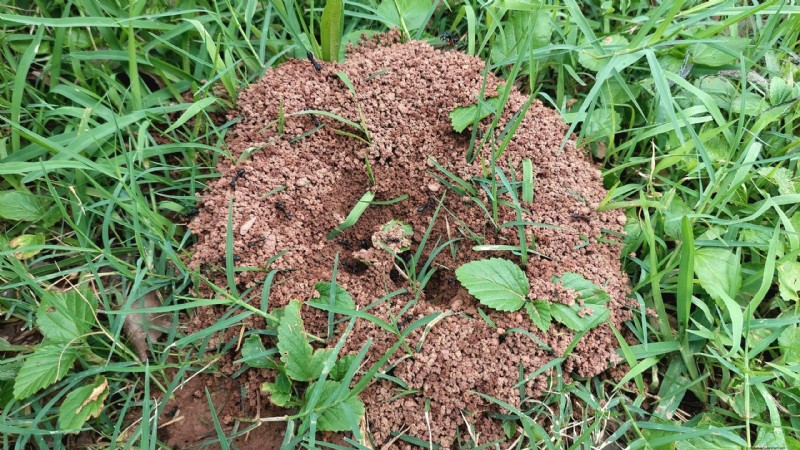
But what if the ants have already arrived? It’s a good idea to continue trying to make your yard less friendly to these tiny creatures, but if you’re already finding problematic ant hills around your property, what should you do?
Here are some natural ways to destroy ant hills so they don’t come back—without ruining your grass in the process.
Raking the ant hill may be the best way to remove ants naturally. It doesn’t pose any safety risk to your grass or yard, so there are really no downsides to this method. Simply rake or otherwise disturb the ant hill, flattening it out to crumble their entry points and ant tunnels.
The ants will rebuild or possibly move their mound a few feet away, so it’s important to rake over the hill consistently for a while until they get the message that they should find another place to build their colony.
Diatomaceous earth is a natural insecticide, and it’s also a natural soil amendment, so you may be able to kill two birds with one stone using this effective method. As ants are exposed to the diatomaceous earth, it slowly dries out their exoskeletons and kills them. It doesn’t work immediately, but that’s actually a good thing, because worker ants will take it back to the nest and spread it to others in the ant colony.
Diatomaceous earth only works when it’s dry, so for best results, it’s a good idea to reapply it after a rain.
Be patient and keep applying it until the ants are all gone. Diatomaceous earth is a fine powder, and while it’s not harmful to humans, it can be irritating if you inhale it while spreading. Be sure to use a food grade product and wear gloves and a mask to minimize irritation.
Spraying a mixture of non-toxic dish soap and water is another effective way to eliminate an entire colony of ants without harming your grass. You only need a little bit of soap and room temperature water, otherwise it may cause harm to the grass.
Combine 1 tablespoon of soap with a quart of water and spray or pour it on the ant nest. You might also consider adding an oil—either canola oil or a few drops of essential oils (such as orange or peppermint oil). The oil sticks to the ants and degrades their exoskeletons faster, and it can also help the mixture to spread deeper down into the ant tunnels. If you do use essential oils, use a minimal amount and be sure to pour the mixture straight down the hole, as concentrated oils can burn the grass.
The best time to apply soapy water is in the morning and evening hours, when most of the ant population is “home” in the ants nest. The cooler hours will also prevent the mixture from drying out as quickly, giving it time to reach more ants.
Note: While the boiling water method is a popular natural option, it’s not a good choice if you don’t want to kill your grass. (This method doesn’t always work, anyway, since the queen ant and other deeper ants may have time to escape before the water reaches all the way down to them.)
If natural methods don’t work or you have a severe ant infestation in your yard, you can turn to chemical treatments and ant baits. It’s important to use these methods carefully, as some of them can be harmful to grass and plants as well as children and pets if used in high concentrations.
Using bait traps can be an effective strategy for easily getting rid of ants without harming your grass or soil. Since you won’t actually be spreading anything over the ground, this method is fairly safe as long as you’re not worried about kids or pets getting into the bait.
The downside of this method is that if you don’t have enough bait stations, ants may sometimes just move to another area of the yard. (Remember, some types of ants build tunnels many feet wide underground, too.)
You can also make your own diy ant bait using boric acid and sugar, but keep in mind that large concentrations of boric acid can harm the grass.
Granular ant killers can be an effective solution, are easy to apply, and are typically safe for grass. Be sure to check the product label and look for one that’s specific to ants rather than insects in general. Many general granular killers won’t kill all species of ants.
Granular products usually need reapplication every so often, especially after a rain. I’ve used Sunday’s Ant Adios with success, and it’s very easy to apply.
Liquid products can drench a mound more quickly, and they’re a good option for severe infestations. The downsides of using a liquid ant killer are that they take a bit more work to mix and are more prone to runoff, which could damage other plants and grass.
Wondercide has a liquid outdoor option, and it gets good reviews though I haven’t tried it myself.
Looking to start a vegetable garden? Check out my FREE 5-day email series about how to start a vegetable garden!