
Welcome to Modern Agriculture!

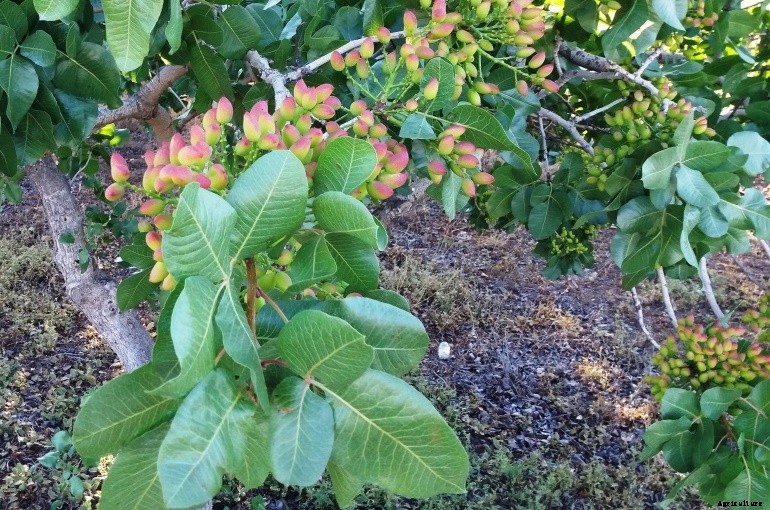
Pistachio (Pistacia vera L., Anacardiaceae or sometimes Pistaciaceae) is a small tree native to some regions of Syria, Iran, Kyrgyzstan, Greece, Turkmenistan, Turkey, Pakistan and western Afghanistan that produces an important culinary nut. Pistacia vera often is confused with other species in the genus Pistacia that are also known as pistachio. These species can be distinguished from P. vera by their geographic distributions (in the wild) and their nuts. Their nuts are much smaller, have a strong flavor of turpentine, and have a shell that is not hard.
Although pistachio trees are long living, with a large tap root, and can grow to 20-30 feet, seedlings can be grown in containers for the first three to five years and then transplanted into the garden. In the garden or orchard, trees should be planted 20 feet apart.Pollination is through wind dispersal of pollen, which usually takes place in early to mid April. Stormy springs may affect crop set by interfering with pollination. Pruning Pistachio Trees Since these trees are classified as fruit trees, pruning pistachio trees is integral to producing higher quality fruit while controlling growth. For young trees, select the three to five branches you wish to use as scaffold branches or the primary structure of your pistachio in April of the first growth season. Choose those that are equally spaced around the trunk but not across from each other with the lowest branch 24-32 inches above the soil and cut all other branches below this. Remove any upper branches that will shade the tree trunk and pinch those that are not scaffolds to 4-6 inches from the trunk. Then in June, prune the scaffold branches to 2-3 feet in length to promote side branching while leaving the lateral shoots to aid in shading the trunk as it grows. Maintain the open center structure as the tree grows taller by choosing secondary scaffold branches. You may prune two to three times a year with summer pruning occurring in the spring and summer and dormant pruning in the fall.
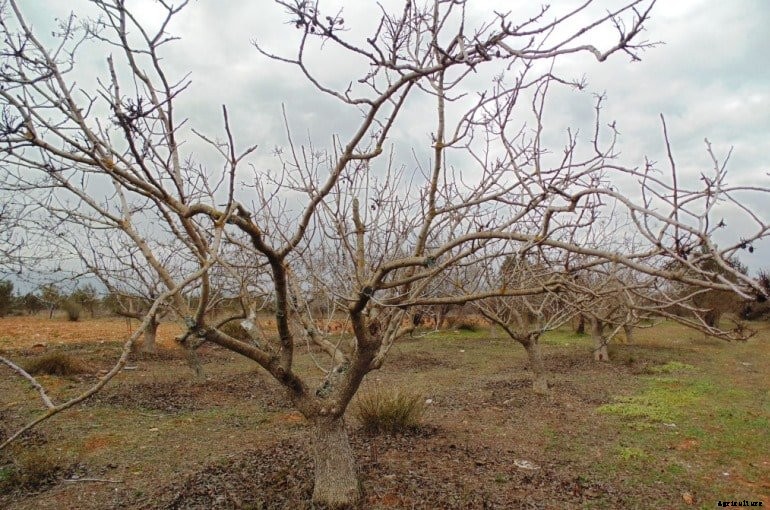
Weather condition is most important factor in growing pistachio crop. These trees preferred a temperature 36 degree centigrade and winter months cold enough to complete their dormant period 7 degree centigrade. These trees don’t grow well in high elevations due to the cool temperature.
Pistachio trees can be grown in wide range of soil ,however well drained deep sandy loamy soils. These trees are quite drought tolerant but don’t do well in areas very high humidity is possible. Soil test would be helpful, if you are planning special production on large scale. Pistachio trees produce high quality Nuts with high yield where soil pH is kept at range of 7 to 7.8. These trees are Hardy ones which can tolerate higher alkalinity to certain extent.
When it comes to preparing the land in this pistachio cultivation, the process should be similar to other nuts crops. Soil should be chiseled and disked to obtain the soil fine tilt stage. If any hardpan is found in the top 6 to 7 feet of soil, it should be broken as pistachio trees are deep rooted in nature and these trees are affected by water stagnation.
Pistachio trees are usually propagated by budding on to a suitable pistachio root stock. These rootstock can be raised in nurseries. Usually, budding is carried out in fall with and the trees are being planted the same year or the following year depending on the size of the rootstock.
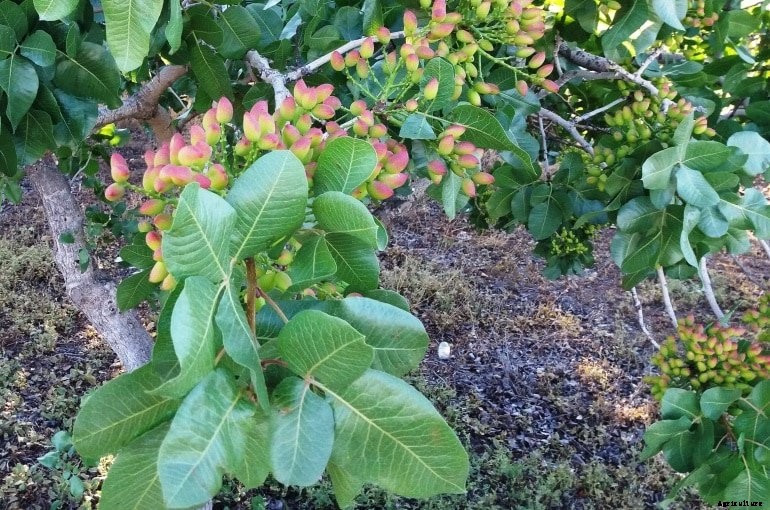
As nitrogen is important fertilizers for any nut crop, pistachios trees have a similar nitrogen requirement just like other nut trees. Subsequently each years should be provided with force 50 grams of Ammonium Sulphate in possibilities is during the growing season in later years actual nitrogen of 45 kilogram to 65 kilogram per acre should be provided nitrogen applied in to split doses over the growing season.
Planting of young pistachio seedlings in the field can take place from late fall (November or definitely after the defoliation has been completed) until the beginning of spring. Before planting, we have to label the tree positions in the field. The pistachio trees should normally not be planted in less than 20 feet (6 meters) distance, especially when the soil is fertile enough. If they are planted in less than 20 feet distances, after a few years, the overcrowding and the mutual shadowing of trees will decrease the quantity and quality of production and will make harvesting and pruning more difficult. Typical distances are 20 X 20 feet (6 X 6 meters), 23 X 23 feet (7×7 meters) and 23 X 20 feet (7 X 6 meters). 20 X 20 feet distances result in 109 trees per acre, or 272 trees per hectare. In small orchards, we have to place ideally 1 male tree in the center of every 7-9 female trees. The position of the male tree must be in the center of every 7-9 female trees, so as to facilitate the dispersal of pollen through the air around the pistachio farm. However, in large pistachio orchards with 600 trees and more, farmers often place 1 male tree every 21 or more female trees. Labeling the tree positions is followed by digging and opening the holes. The holes have typically dimensions 1.5 X 1.5 feet (45 X 45 cm) and a depth of 2 feet (60 cm). Keep in mind that the young pistachio trees are often planted with the nursery’s soil ball attached to their sensitive root system. When we put the young trees in the holes, we also place the supporting stakes. The seedlings must be planted at roughly the same depth as they were planted in the nursery, and then we have to put plenty of surface soil to the base of the root system of seedlings. When adding the soil, we have to press it gently, until the complete filling of the pits, so as to avoid causing damage to the young and sensitive root system. Planting is followed by the watering of seedlings. Many pistachio farmers then add a small amount of manure around the seedling base. They do this in order to prevent the germination of weeds’ seeds and to maintain adequate soil moisture. These two factors can significantly affect the growth of seedlings during their first years.
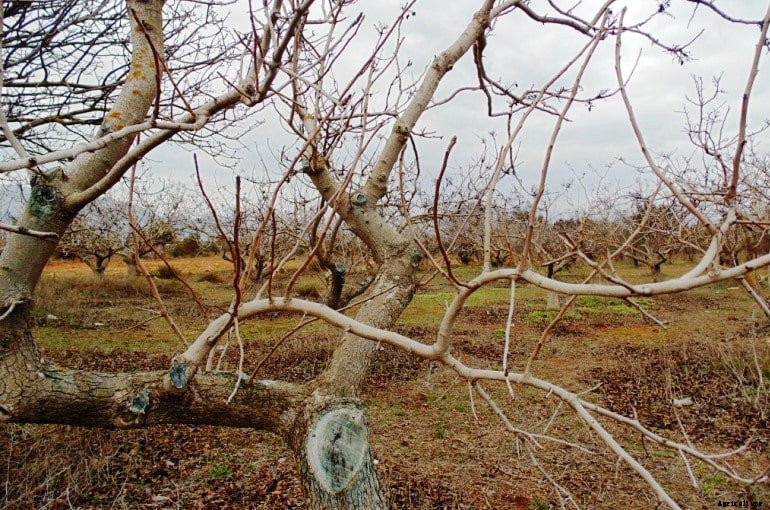
In general, pistachio trees need less pruning than other fruit trees (apple, citrus etc.) However, the same rules of fruit trees pruning apply. In a few words, we prune (or “train”) young trees during their second spring in order to determine their shape (crown skeleton). The shape is very important and can affect production quantity, quality and ease of harvesting or other farming activities. On the other hand, we prune mature trees in order to maintain their shape and open up the inner part of the tree, so that aeration and sunlight penetration will be improved. We also prune mature trees in order to remove broken, weak or diseased branches, and of course get rid of suckers. All the previous operations promote fruit production in the long term. Young pistachio trees are usually trained during their second spring in a way so that they can finally bear heavy crops that can be easily harvested. We can manage the proper shape by tipping the top of the tree once the scion (the upper part of the tree that was budded to rootstock) reaches a height of 40 inches (1 meter). This tipping will promote the appearance of 3-4 primary branches from this point. These will be selected as the primary branches of the tree. They will form the basic skeleton of the tree and thus they must not cross each other. We then tip each of the primary branches when they reach a length of 15 inches (38 cm). This promotes the growth of secondary branches from each primary branch, which we will also tip when they reach a length of 25 inches (63 cm.) In general, pruning of a healthy and mature pistachio tree should be light (remove maximum 10-15% of the tree crown), because severe pruning (more than 30% of the crown) has been found to increase the percentage of closed fruits. However, very weak trees should be pruned severely. Pruning should be normally held during late winter – early spring and definitely when the tree is still dormant. During the summer, we can remove young shoots, having a length of 30 inches (75 cm) or more, so as to avoid their possible bending downwards. The desired angle of shoots is about 45 degrees. This operation promotes side vegetation and speeds up the development of the crown skeleton. The inner part of crown of trees should be kept open, so that it will have access to plenty of sunlight. Sunlight is necessary for the formation of flower buds and thus is proportionate to production. After creating the basic skeleton of the tree crown, only light pruning is allowed. We generally cut 1 year limbs to 20 inches (50 cm.) Remember that in mature trees of 15 years and older, the fruit bearing parts are always at the upper half of the canopy. Consequently, pruning upper limbs must be limited. Male pistachio trees are usually not pruned. They normally reach a greater height than the female trees, because the pollination of pistachio trees is facilitated this way. Male trees are pruned only when they hinder the growth of females, when they cause difficulties in harvest and when we try to delay their flowering.
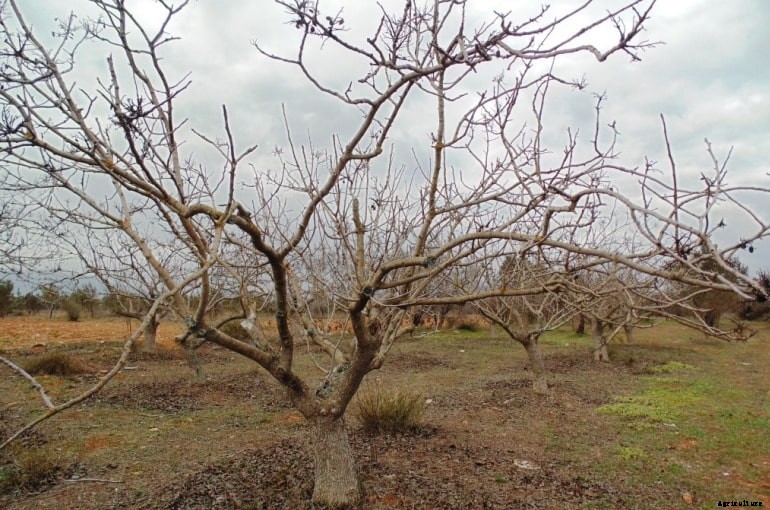
Although considered tolerant to drought, pistachio tree systematically gives higher yields when water is available, especially during the summer months. In general, water stress promotes the phenomenon of alternate bearing. Pistachio trees have high water requirements especially during the filling of nuts 6 (summer). However, farmers shall not supply very large quantities of water at few sessions in mature trees, because the tree vegetation can grow excessively and this can negatively affect the opening of the fruit. In most cases, farmers provide at least 4-6 irrigation sessions during the productive period in light and well drained soils.
Pistachios split before they are harvested. Thus, they must not fall in the ground, because they run the risk of contamination from soil microorganisms. The fruits that fall in the ground do not get harvested and they are left there as compost to the trees. Harvesting of pistachio tree begins late depending on the variety and the region, and lasts about 15 to 20 days. Contrary to citrus, apples and other fruit trees, all pistachio fruits in a tree do not normally mature at the same time. Consequently, harvesting takes place in 2 or 3 stages (2-3 “hands”). The first hand is usually harvested when 60-70% of the fruits have ripened. Harvesting of pistachio trees is a labor intensive procedure when made by hand, by shaking the trees with special hand equipment. The fruits fall underneath the canopy of trees, over outstretched sails or collection nets. Then, the fruits are sorted in piles and a rough screening follows in order to remove fallen leaves, broken seeds and shoots. Immediately after sorting or maximum after 10-12 hours, they are spread out in a cool place, and the nuts should be peeled, otherwise their quality will be deteriorated.
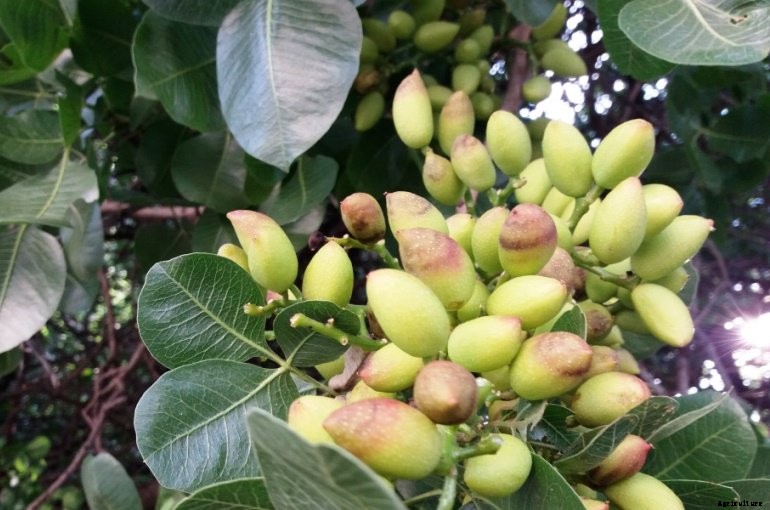

It is a soil borne fungal disease that enters the pistachio tree through the root system and can finally kill the tree. After some years, it actually blocks the water and nutrients that are supposed to be transferred from the roots to the upper parts of the trees, resulting in the collapse of whole branches. It is created from the pathogen Verticillium dahliae. Verticillium wilt has created huge economic loss in the pistachio orchards. Unfortunately, the pathogen can live in the soil for many years, without any plant host. The first precaution against Verticillium wilt would be to keep a field fallow for 4 years, if cotton or Solanaceae species (Tomato, Potato, Tobacco) were cultivated in this field. The second precaution against Verticilium is to select a rootstock that is resistant to this disease .Over irrigation and the presence of certain weeds favor the rapid spread of the disease.
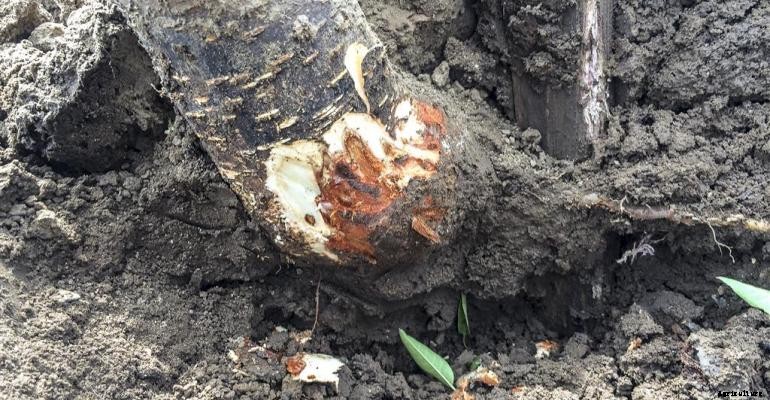
Phytopthora root rot is a soil borne fungal disease. The pathogen initially attacks the roots and makes them weak. This will finally block the water and nutrients that are supposed to be transferred from the root systems to the upper part of the tree. As a result, pistachio trees will suffer from slow growth, defoliation and reduced fruit set and production. The pathogen can live several years in the soil, without depending on a plant host. Heavy and waterlogged soils favor the spread of the disease. Armillaria root rot, Pistachio dieback (Xanthomonas translucens) and Septoria leaf spot are also famous pistachio tree diseases.


