Welcome to Modern Agriculture!

For most DIY concrete projects, the amount needed to complete the job is measured in cubic yards. The standard concrete measuring device usually available is a wheelbarrow. We have researched a simple method you can use to convert the number of wheelbarrow loads necessary to accomplish any concrete job.
The wheelbarrow capacity will determine how many loads it takes to complete 1 cubic yard or 27 cubic feet of concrete. Generally, a 3 cubic foot wheelbarrow requires 9 loads (3×9=27).
The article includes ways to calculate the amount of concrete you need based on its weight as well as the number of loads it takes to complete specific projects. Please keep reading to learn more!

One yard is equal to 3 feet, therefore, 1 cubic yard is equal to 27 cubic feet. This is the three-dimensional standard of measurement we’ll use moving forward with this discussion.
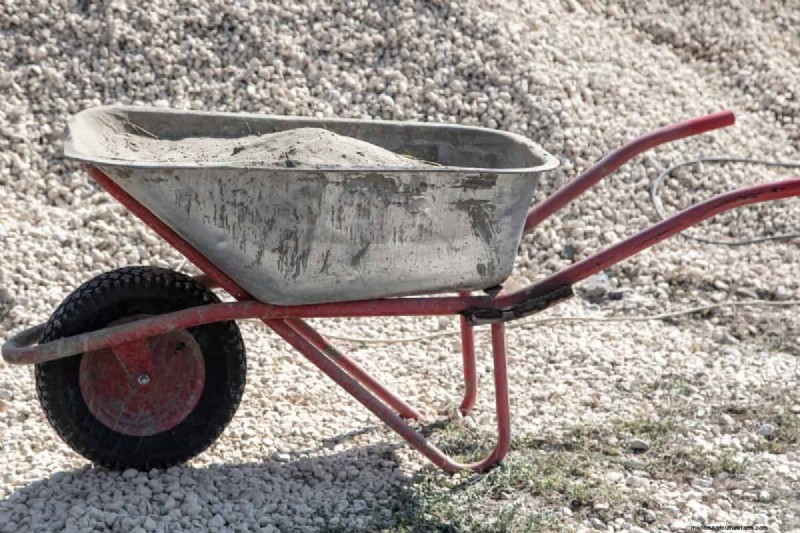
Wheelbarrows are an excellent way to transport different materials of considerable weight from one area of your property to another. They are available in different capacities, from a typical garden variety that can hold 2 to 3 cubic feet to a contractor-grade model which can carry up to 6 cubic feet of material.
Usually, the capacity is specified on a sticker on the wheelbarrow’s side or embossed on the wheelbarrow’s metal. However, if you are unsure of its actual limit, there is a simple way to determine its allowable cargo volume.
A cubic foot contains 7.5 gallons of water. Fill your wheelbarrow about 3/4 of its capacity with water. If it can contain 15 gallons, this is the equivalent of 2 cubic feet. If it can hold 22.5 gallons below the rim, then its capacity is equal to 3 cubic feet.
Once you’ve established the capacity, you can now calculate the number of loads needed for 27 cubic feet or 1 cubic yard of wet concrete. Simply divide 27 by the wheelbarrow’s allowable volume.
To illustrate, 27 divided by 3, which is the wheelbarrow’s capacity in cubic feet, equals 9, which is the number of loads needed.
If you own a deep tray wheelbarrow that can carry 6 cubic feet (45 gallons) of material, then 27 divided by 6 equals 4.5 loads.
Knowing the volume capacity of your wheelbarrow gives you the advantage of calculating the number of trips necessary to transport gravel from one point to another to undertake and complete a project.
This reference becomes important if you are working on a comparatively large area to pave or pour concrete. The number of loads and consequent trips would factor out where to strategically place or position the concrete load.
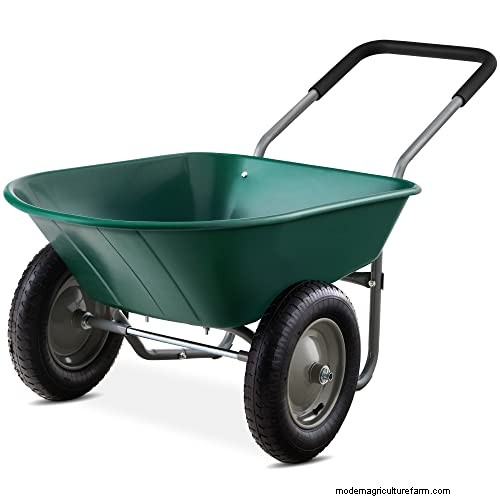
Check out Wheelbarrow Garden Cart on Amazon.
We'll email it to you so you can read it later!
By saving, you agree to receive occasional emails. Unsubscribe anytime.

How much material is actually needed for a cubic yard or 27 cubic feet of concrete?
The standard weight for dry concrete is 3,600 pounds and about 4,050 when mixed with water.
Premixed concrete comes in bags containing 90, 80, and 60 and other weights in pounds. Simply divide the total dry weight (3,600 pounds) by the weight of the bag you purchased. You will need:
The weight of the concrete material will give you a more accurate or precise estimate of just how many bags are needed to accomplish the task.
This will prevent a lack or excess of usable concrete. However, it is advisable to give an allowance in terms of volume to replace any spills, fill necessary gaps or flatten out uneven surfaces.

The following section gives a few illustrations of the practical application of the above conversions and measurements.
We have established that 27 cubic feet of dry concrete weighs 3,600 pounds (3,600 pounds divided by 27 = 133.3 the weight of 1 cubic foot of concrete).
Since the project totals 12 cubic feet, you need 133.3 x 12 = 1,600 pounds of premixed dry concrete or twenty 80-pound bags (1,600/80 = 20).
Finally, it would take four loads of wet concrete for a wheelbarrow with a capacity of 3 cubic feet (4 loads x 3 cubic feet = 12 cubic feet).
It would take seven loads of a wheelbarrow with a capacity of 3 cubic feet (21.33/3 = 7.11)
Since you need four posts, the total becomes 6 cubic feet
The weight and number of 80-pound bags needed: 6 cubic feet x 133.3 pounds per cubic foot = 799.8 pounds of premixed concrete or ten 80- pound bags.
It would only take two loads of a wheelbarrow with a capacity of 3 cubic feet

Using premixed concrete bags is convenient and more reliable since the proportion of cement to aggregates has been predetermined more accurately in terms of structural standards.
The right amount of water introduced into the mix will ultimately determine the strength and durability of the compound. With premixed concrete, you will simply have to follow the instructions in the bag and confidently work on any project.
However, what is the ratio of the materials if you decide to prepare the mix yourself? Concrete is composed of cement, sand, gravel, and water; a 1:2:3:0.5 is the standard proportion for general all-around purposes.
The simplest way to get the mix right is to use a pail or bucket to measure each ingredient accurately. Use 1 part cement, 2 parts sand, and 3 parts concrete and premix them until the components are distributed evenly before adding the water.
Take note that the 0.5 ratio of water is relative only to the amount of cement and does not include the sand and gravel components. Add the water gradually, and mix the compound thoroughly until a uniform texture is achieved.
Use the least amount of water that will allow a workable mix since the amount of hydration is the most important determining factor of the concrete’s strength and integrity.
The 1 part cement to 0.5 part water ratio is the highest proportion structurally advisable. It is actually ideal for lessening the amount of water as long as the mixture is not too heavy to work with.
If you are working on a large surface area, measuring the components with buckets might be too labor-intensive. In this case, a 27 cubic foot mix would need approximately five 90-pound bags of cement, 10 cubic feet of sand, and 15 cubic feet of gravel, with around 27 gallons of water.

The capacity of the wheelbarrow determines the number of loads necessary to accumulate a cubic yard or 27 cubic feet of concrete. Simply divide 27 by the volume that you can accommodate in your transporter. We hope the article clarifies your question and helps you determine the necessary measurements to complete the task.
You might also find these topics informative:
How To Remove Raised Beds From A Garden [Step-By-Step Guide]
Can You Build A Retaining Wall On Concrete? [Plus How-To Tips]