
Welcome to Modern Agriculture!

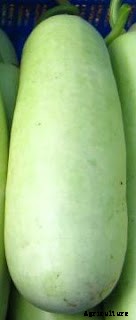
Bottle gourd (Lagenaria siceraria) is a widely grown tropical vegetable which has high carbohydrate content. Oil can be extracted from the seed kernel and is used in hair care products. The hard shells of the bottle gourd can be used as utensils, or floats in fishing nets and even musical instruments, due to its resonating property.
Bottle gourds require well drained and sandy loam soils for its good cultivation. It cannot tolerate higher amounts of acidity, alkalinity or salinity, pH range is between 5 to 5.5. When soil conditions are not optimum, then production of female flowers is greatly affected.
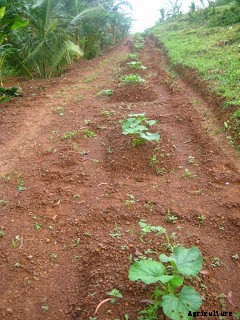
Ten days after sowing thinning out has to be done & 21 days after sowing min of 2 seeds must be retained in every bed.
It can be grown almost in all climates; however, too much rainfall is not good. Optimum temperature range is between 30 to 35 degrees during day. If temperature is very high, then more number of male flowers are formed thereby decreasing yield.
Since we are discussing monsoon techniques for growing bottle gourds, the land selected must have good drainage. To attain this at least 3 repeated ploughings must be done. Raised seed beds are made up to height of 30 cm & distance between beds must be maintained at minimum 2 meters.
<img
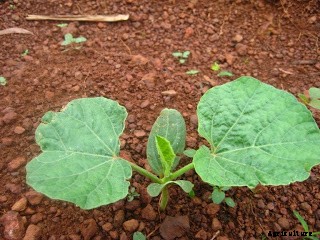
Irregular leaf shape is due to heavy rainfall & pest attack. Spraying with systemic insecticides like dimethoate @ 1 ml per litre every week till plant is healthy is done.
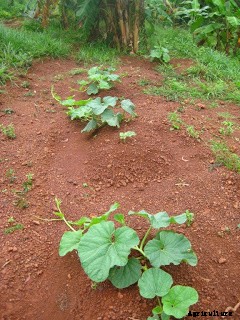
Lush green leaves indicates good nitrogen in the soil.
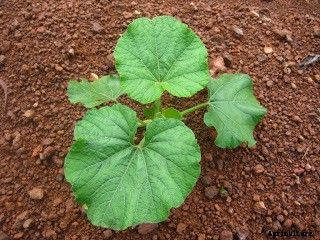
In the presence of optimum sunlight, the leaves are able to prepare their own food & the plants appear much healthier.
Irrigation is not given during monsoon, but when there is dry spell, light irrigation must be done just to replenish soil moisture. In summer irrigation is carried out thrice a week. If proper mulching is done, irrigation can be reduced to twice weekly.
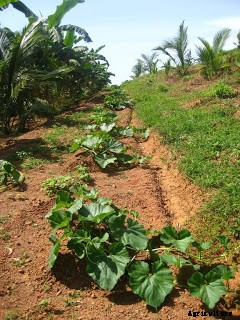
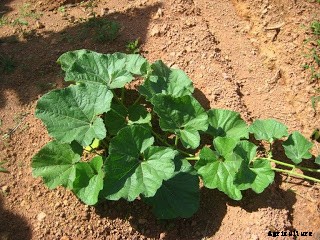

The 3 photos above show the crop development after 35 days after sowing. Care must be taken to see that the growing vines are free from developing weeds, or it will hinder harvesting.
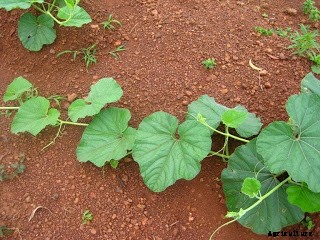
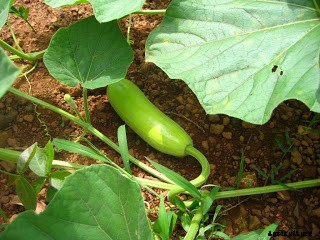
Development of fruits, fruit setting seen
Requires good amounts of organic manure. Since it is a long duration crop, it is highly beneficial to add manures in split doses. Bulky organic manures can be added to the soil every 20 days, while it is good to add complex fertilizers at least once every month.
It responds great to foliar applications as well. The number of female flowers can be increased using plant hormones like NAA, naphthalene acetic acid @ 1 ml per litre, just during flowering stage.
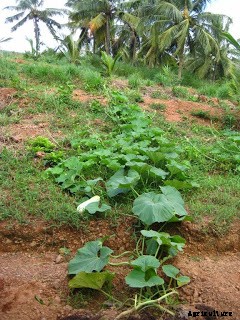
A healthy bottle gourd plant, which seems to be climbing. The vines can grow up to 20 feet, if left unchecked & hence thinning out is done to avoid overcrowding. Also distance is maintained between beds for this reason.
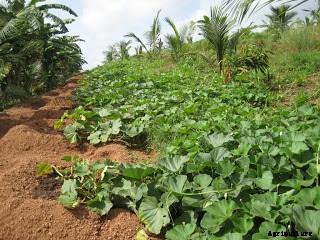
Flowering can be observed. The plant continues to grow & the vines cover the complete area giving a carpet like appearance.
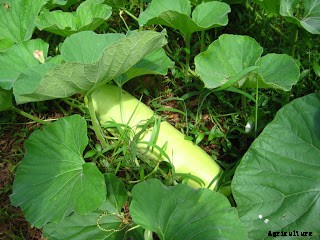
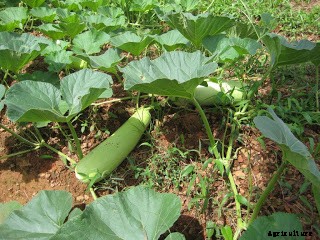
Fruit setting in the above 2 photos
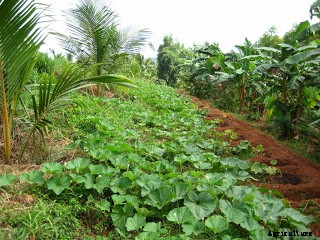
The green carpet cover.
Alternaria leaf blight (Alternaria cucumerina)
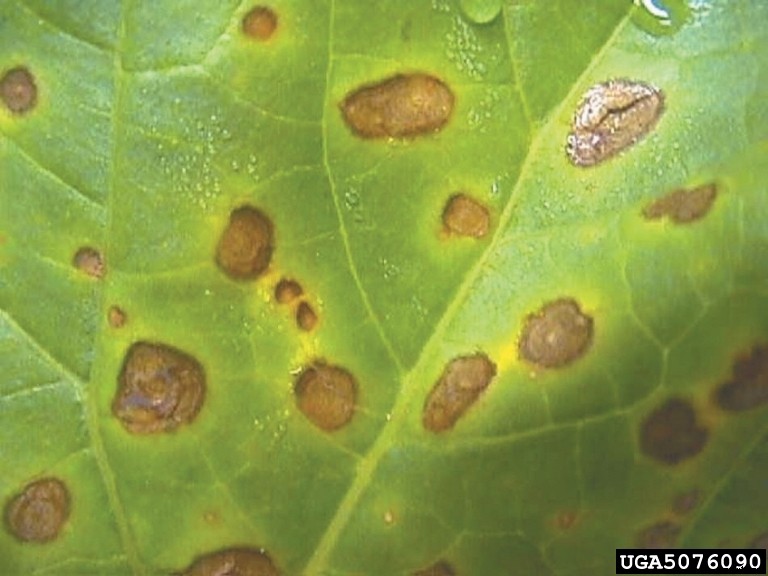
Small, yellow-brown spots with a yellow or green halo which first appear on the oldest leaves; as the disease progresses, lesions expand and become large necrotic patches, often with concentric patternation; lesions coalesce, leaves begin to curl and eventually die.
Fungus
Disease is prevalent in growing areas where temperatures are high and rainfall is frequent.
Cucurbits should be rotated with another crop every 2 years to reduce levels of inoculum; crop debris should be removed from the field as quickly as possible after harvest or plowed deeply into the soil; applications of appropriate protective fungicides can help to slow the development of the disease; water plants from the base rather than from above to reduce periods of leaf wetness which are conducive to the development and spread of disease.

Small water-soaked lesions on leaves which expand between leaf veins and become angular in shape; in humid conditions, lesions exude a milky substance which dries to form a white crust on or beside lesions; as the disease progresses, lesions turn tan and may have yellow/green edges; the centers of the lesions dry and may drop out leaving a hole in the leaf.
Bacterium
Spread through infected seed, splashing rain, insects and movement of people between plants; bacterium overwinters in crop debris and can survive for 2.5 years.
Use disease-free seed; do not grow plants in field where cucurbits have been grown in the previous 2 years; protective copper spray may help reduce incidence of disease in warm, humid climates; plant resistant varieties.
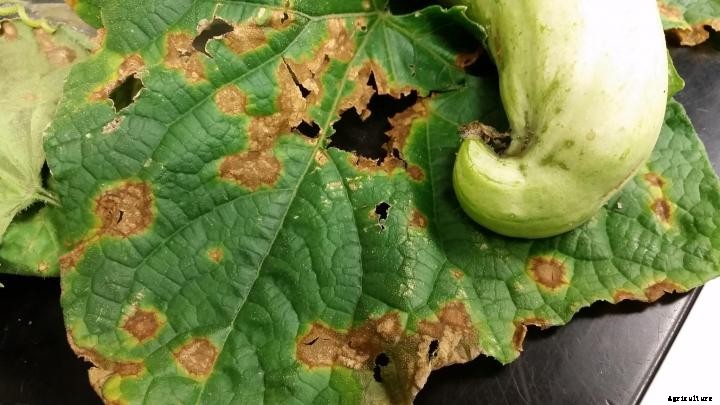
Tan to brown lesions with dark spots inside on leaves and petioles, main stem and fruit.
Fungus
Disease favors warm weather
Plant resistant varieties; use only certified seed; apply appropriate protective fungicides; rotate crops every year.
Foliage turning yellow; secondary shoots begin growing prolifically; stems take on a rigid, upright growth habit; leaves are often small in size and distorted, may appear thickened; flowers are often disfigured and possess conspicuous leafy bracts; fruits are small and pale in color.
Phytoplasma
Disease is transmitted by leafhoppers and can cause huge losses in cucurbit crops.
Remove any infected plants from the field to reduce spread; control weeds in and around the field that may act as a reservoir for the phytoplasma; protect plants from leaf hopper vectors with row covers.
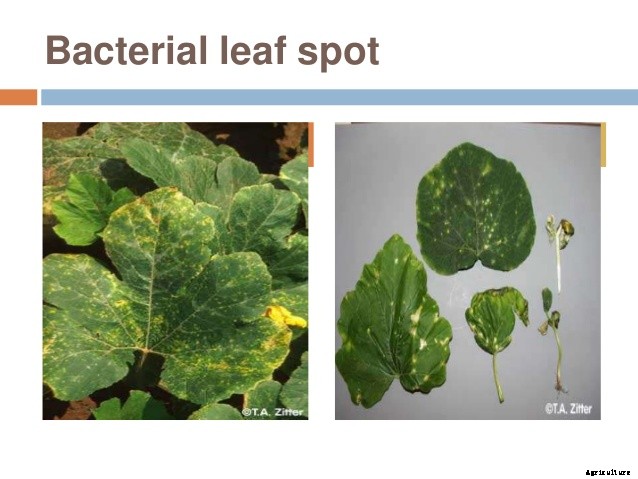
Dark, angular lesions on leaves; leaf lesions may coalesce and cause severely blighted foliage; water-soaked lesions which enlarge and develop into tan scabs, or blisters, on the fruit; blisters eventually flatten as they reach their full size.
Bacterium
Disease can spread rapidly in a field; disease can be introduced through contaminated seed.
Avoid overhead irrigation; rotate crops away from cucurbit species to prevent disease building up; use new seed each planting as saved seed is more likely to carry bacteria; apply appropriate protective fungicides; copper containing fungicides generally provide good control.
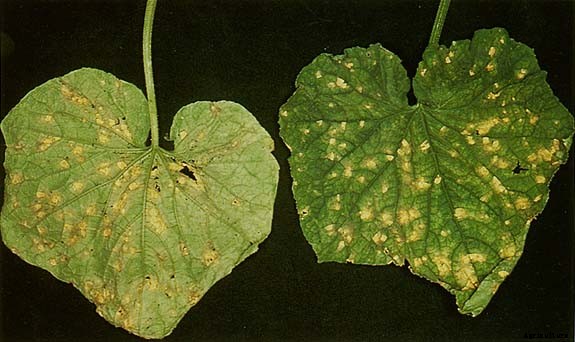
Initial symptoms of disease occur on older leaves as small spots with light to tan brown centers; as the disease progresses, the lesions enlarge to cover large areas of the leaf surface; lesions may have a dark border and be surrounded by a chlorotic area; the centers of the lesions may become brittle and crack/
Fungus
Fungus survives on plant debris; spread by wind and water splash; occurs mainly in tropical and subtropical growing regions.
Any diseased plants should be removed and destroyed to prevent further spread; crop debris should be removed after harvest or plowed deeply into the soil to reduce inoculum.
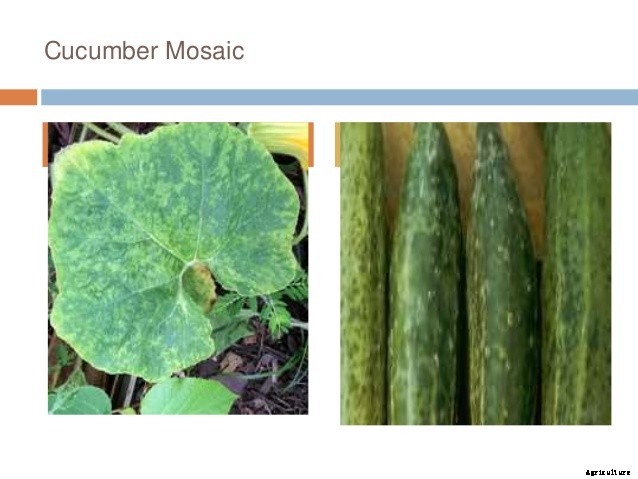
Plants are severely stunted; foliage is covered in distinctive yellow mosaic; leaves of plant curl downwards and leaf size is smaller than normal; flowers on infected plants may be deformed with green petals; fruits become distorted and are small in size; fruit is often discolored.
Virus
Transmitted by aphids; virus has an extensive host range; can be mechanically transmitted via tools etc.
Control of the virus is largely dependent on the control of the aphid vectors; reflective mulches can deter aphid feeding; aphid outbreaks can be treated with mineral oils or insecticidal soap applications; some resistant varieties are available.
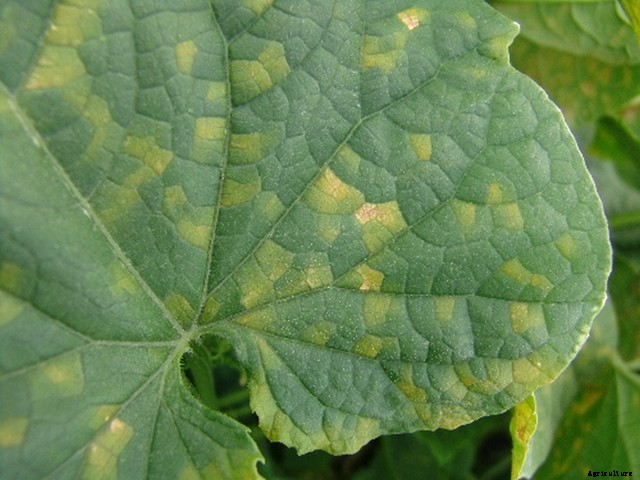
Symptoms of downy mildew on underside of a gourd leaf.
Angular brown lesions on upper side of leaves; purple to gray spores and gray mold on underside of leaves; brown leaves; dead leaves that remain attached.
Fungus
Disease favors cool, humid weather.
Do not overcrowd plants; avoid overhead irrigation, water plants from base; apply appropriate fungicide.
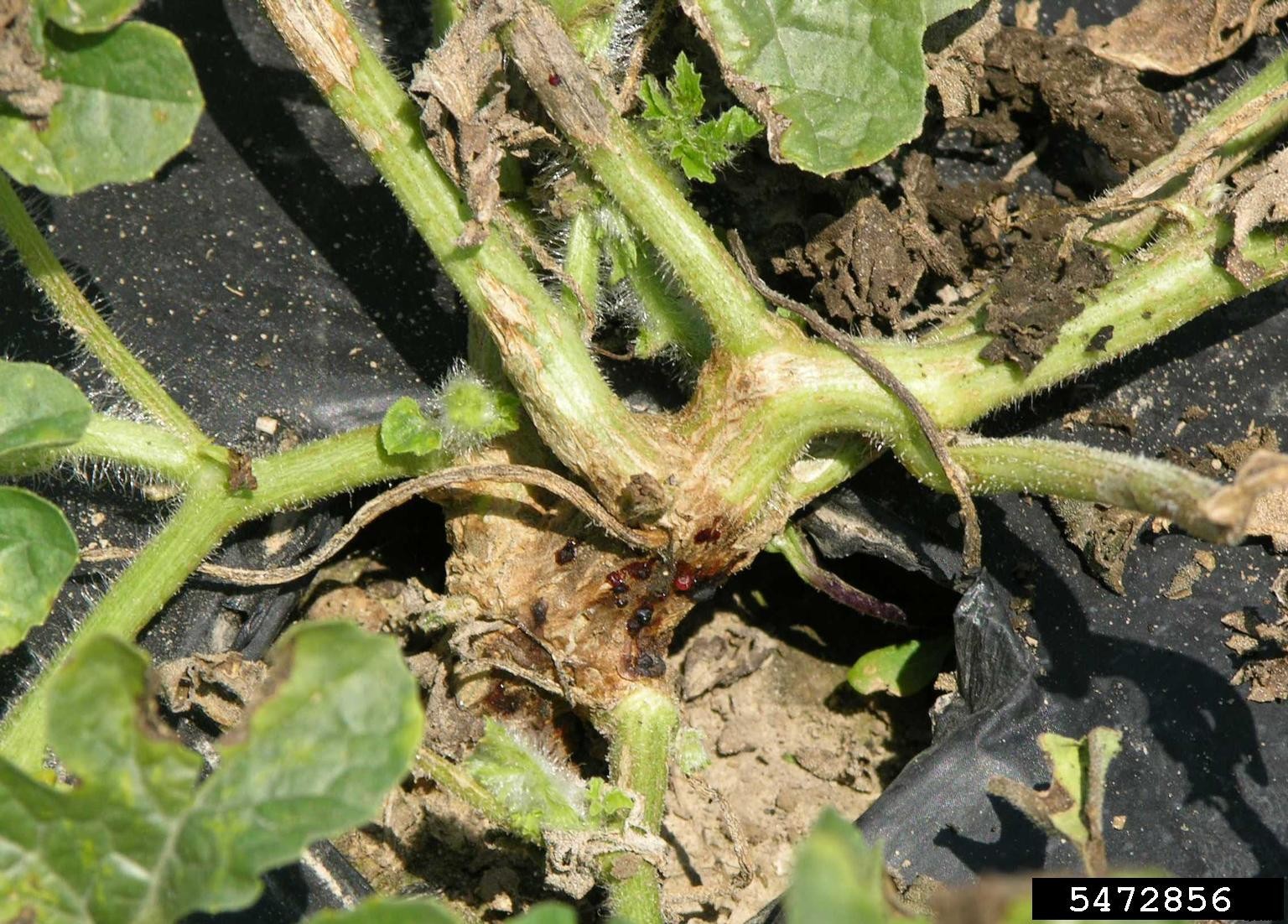
V-shaped yellow to brown areas on stem; cracked dry areas on stem; lesions leaking a sappy material.
Fungus
Disease may be seed-borne.
Use disease free seed; treat seeds prior to planting; rotate crops every 2 years.
Sudden wilting of plants; brown lesions on stems and roots; rotting fruit; stunted plant growth; downy growth may be present on lesions during periods of high humidity.
Oomycete
Disease emergence favored by heavy rainfall and poorly draining, waterlogged soils.
Do not plant in poorly draining soils; avoid over-watering plants; rotate cucurbits with non-susceptible plants for a period of at least 3 years.
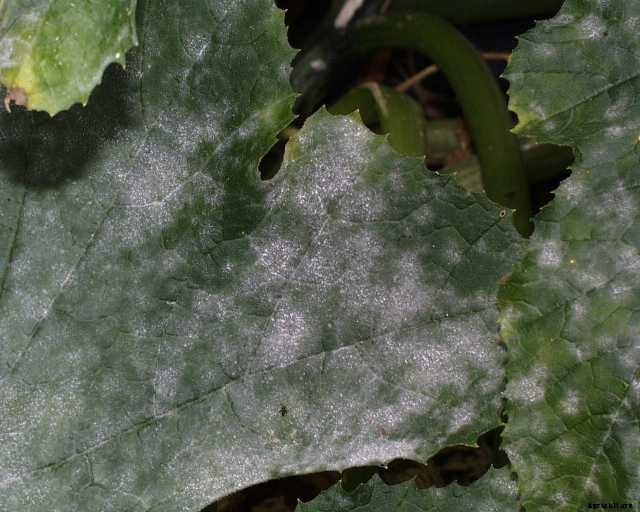
Powdery, white spots on the undersides of leaves; yellowing leaves
Fungus
Disease emergence favored by dry weather and high relative humidity.
Plant in sites with good air circulation and sun exposure; do not overcrowd plants; sanitize equipment regularly.
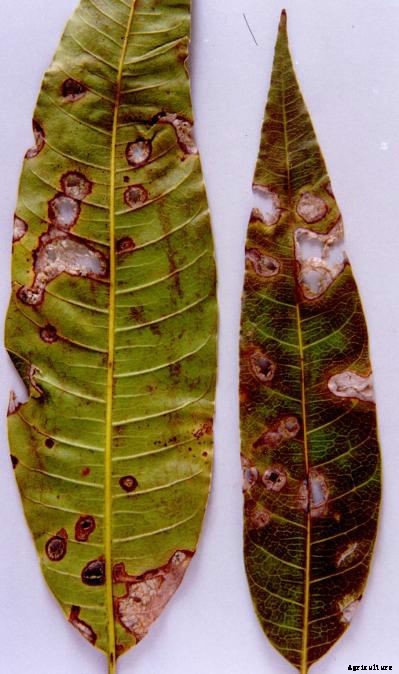
Scab symptoms on gourd fruit.
Angular brown lesions on leaves confined by small veins; pale green and water soaked lesions; holes in leaves from dried out lesions; lesions may also be present on petioles, stems and fruit.
Fungus
Fungus survives in soil on crop debris; may be seedborne; disease emergence favored by wet weather and temperatures below 21°C (69.8°F)
Rotate cucurbits with non-susceptible crops for a period of at least 2 years; plant only in well-draining soils; spray plants with appropriate protective fungicides.
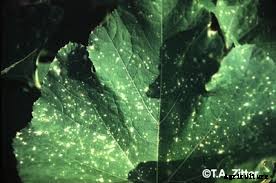
Initial symptoms of disease are small dark water-soaked spots on the leaves which turn beige to white in dry conditions; lesions develop thin brown borders and the centers may become brittle and crack; small white spots may erupt on the surface of infected butternut and acorn squash and pumpkin fruit.
Fungus
Pathogen can survive on crop debris for periods in excess of 1 year.
Scout plants during cool wet conditions for any sign of spots; early application of an appropriate protective fungicide can help limit the development of the disease if spots are found’ cucurbits should be rotated with other crops every 2 years to prevent the build-up of inoculum; crop debris should be removed and destroyed after harvest.
 =
=
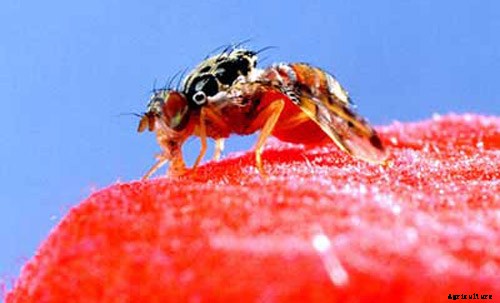
Apply Carbaryl 10% DP in pit before sowing of seeds to destroy the pupae. In homestead gardens the fruits may be covered with polythene, cloth or paper bags to ensure mechanical protection. In large gardens apply carbaryl 20 to 25 grams or malathion 30 to 40ml in 15 ltrs of water containing sugar at fortnightly intervals at flowering and fruit initiation. Remove and destroy affected and decayed fruits.
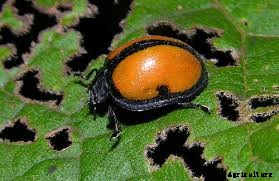
Remove and destroy egg masses, grubs and adults occurring on leaves. Spray Carbyl 20 to 25 grams per 15 litres.
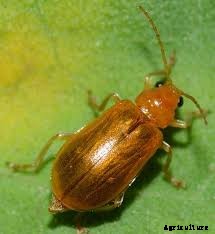
Adult beetle eats the leaves , makes hole on foliage and causes damage on roots and leaves. Incorporate carbaryl 10% DP in pits before sowing the seeds to destroy grubs and pupae.
Bottle gourds can be harvested after 55 to 75 days after sowing. Care must be taken while harvesting to see that proper tender and ripe fruits must be harvested. The developing tender fruits will have green color & the seed coat & rind are tender. It is best to harvest at this stage. Sometimes, harvesting is done depending on the size it attains. Smaller fruits are in great demand as compared to bug sized fruits. When the color changes from green to white, the seed coat and rind hardens & then it becomes over ripe & unfit for consumption. Such fruits are kept for formation of seeds, which can be extracted once the fruit completely dries up. Some varieties can yield up to 20 tonnes per hectare.
In many cases, especially during monsoon, the growing vines are pruned to allow more lateral branching. Vines which are bit old & semi hard are pruned to get the desired result. In some other cases, the vines are allowed to train on coconut ropes grown on bower of bamboo sticks. This is done to prevent the developing fruits from coming in contact with soil & rotting.


